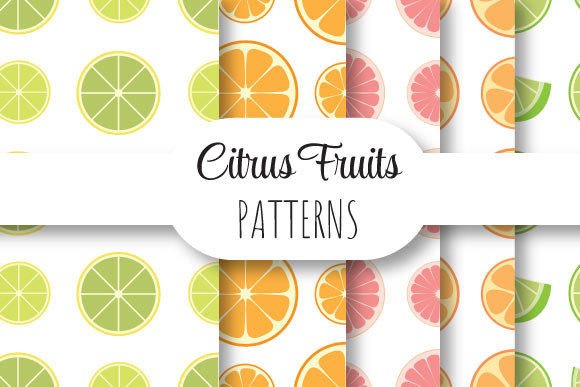
Citrus Fruits Seamless Vector Patterns
Citrus Fruits refers to a curated digital design asset pack featuring five original, hand-crafted seamless vector patterns inspired by citrus fruits—such as oranges, lemons, limes, and grapefruits. Each pattern is built for scalability and precision, delivered in both EPS 10 and high-resolution JPEG formats. All files measure 12 × 12 inches (3600 × 3600 pixels) at 300 dpi, optimized for professional print and high-fidelity digital use.
Why Designers and Print Professionals Consider Citrus Fruits
Designers evaluating pattern libraries often seek assets that balance visual freshness with technical reliability. Citrus Fruits meets this need by offering botanical motifs grounded in real-world fruit textures and color palettes—yet abstracted enough to function as versatile background elements. The patterns avoid photorealism in favor of stylized, repeatable geometry: segmented citrus cross-sections, clustered peel textures, or rhythmic arrangements of leaves and fruit silhouettes.
Interest in Citrus Fruits typically arises in three contexts: commercial print projects (e.g., packaging, stationery, fabric), branding initiatives requiring warm, approachable visual language, and digital interfaces where organic, non-geometric patterns add subtle depth without overwhelming content.
Key Benefits of the Citrus Fruits Pack
- Technical consistency: All five EPS files are native Illustrator-compatible (EPS 10), preserving full vector editability—paths, swatches, and layers remain intact for customization.
- Print-ready resolution: The 3600 × 3600 pixel JPEG versions match the same physical dimensions and DPI, enabling immediate use in raster-based workflows without upscaling artifacts.
- Seamless tiling behavior: Each pattern was constructed using precise offset and alignment methods, verified across multiple tile repetitions to eliminate visible seams at any scale.
- Color flexibility: Vector files support easy recoloring via global swatches or Live Paint, making adaptation to brand palettes straightforward.
- File organization: The ZIP package delivers matched pairs—each EPS has a corresponding JPEG—reducing confusion during asset selection or handoff.
Tradeoffs and Practical Considerations
Citrus Fruits prioritizes cohesion over variety. While the five patterns share a unified aesthetic language—warm yellows, greens, and creams with soft contrast—they do not include high-contrast monochrome variants, metallic finishes, or distressed textures. Users seeking maximal stylistic range may find the set intentionally narrow.
The 12 × 12 inch canvas size suits standard print applications but may require adjustment for very large-format output (e.g., wall murals above 48 inches). Though vector-based, extremely aggressive scaling—beyond 200% in some layout software—can expose minor anchor point complexity in intricate segments; testing at final output size is recommended.
EPS 10 compatibility ensures broad support across Adobe Creative Suite versions, but newer tools like Affinity Designer or Figma may require conversion to SVG or PDF for full editing fidelity. JPEGs serve preview and raster integration needs but cannot be edited non-destructively.
When Citrus Fruits Is a Strong Fit
This pack works well when the project calls for natural, inviting, and seasonally resonant visuals—without resorting to clichéd photography or generic clip art. It is especially appropriate for:
- Food-related branding (juice labels, café menus, artisanal product packaging)
- Stationery suites aiming for warmth and tactility (wedding invites, greeting cards, business cards)
- Textile or wallpaper design where organic rhythm supports, rather than competes with, form
- Educational or wellness materials emphasizing freshness, vitality, or nutrition
- UI backgrounds for apps or websites targeting health, lifestyle, or culinary audiences
In these cases, Citrus Fruits provides a predictable, on-brand foundation—saving time spent building custom repeats from scratch while retaining creative control through editable vectors.
When Alternatives May Be Worth Exploring
Citrus Fruits is less suitable when the project demands:
- Highly geometric or minimalist patterns: Its organic structure doesn’t translate to strict grids, tessellations, or Bauhaus-inspired repetition.
- Dark-mode or low-light interface use: The palette leans into mid-to-light tones; dark-background applications may require manual contrast adjustments or supplemental assets.
- Multilingual or culturally specific symbolism: While citrus carries broadly positive associations (vitality, zest, refreshment), some regional contexts link specific fruits to particular meanings (e.g., bitter orange in certain Mediterranean traditions); designers working with nuanced cultural narratives should verify appropriateness.
- Animated or interactive patterns: The pack contains static files only—no motion graphics, Lottie files, or CSS-tile code. Projects needing dynamic repetition require additional development.
- Ultra-niche botanical accuracy: These are stylized interpretations—not scientific illustrations. Botanical illustrators or educational publishers requiring taxonomic precision should supplement with reference imagery or specialized resources.
Making an Informed Decision
To determine whether Citrus Fruits aligns with your goals, begin by reviewing your intended output medium and scale. If you’re producing printed packaging at 300 dpi or designing a responsive website background that scales cleanly, the included file specifications meet those requirements directly.
Next, assess your workflow. If your team relies heavily on Illustrator and values editable vectors for consistent color application across deliverables, the EPS files offer clear utility. If your process centers on Figma or Canva—and you lack access to Illustrator for initial edits—the JPEGs provide fallback usability, though with reduced flexibility.
Finally, consider visual hierarchy. Citrus Fruits patterns function best as supporting elements: backgrounds, borders, or textural overlays. They are not designed to serve as primary focal points or standalone icons. If your layout depends on bold, singular graphic statements, pairing one of these patterns with a strong typographic or photographic element will yield more balanced results than relying on the pattern alone.
For evaluators comparing similar assets, examine how each pattern behaves under tile repetition—not just in isolation. Zoom in on seam lines in your preferred design tool. Test recoloring across two or three brand colors. Simulate how the pattern appears behind body text at typical line heights. These practical checks reveal more about real-world performance than spec sheets alone.
Citrus Fruits offers a focused, technically sound solution within a specific aesthetic and functional range. Its value lies not in breadth, but in reliability—making it a practical choice for designers who prioritize executional clarity over expansive variety.